
Why the Next Decade Demands Evidence, Participation, and Innovation
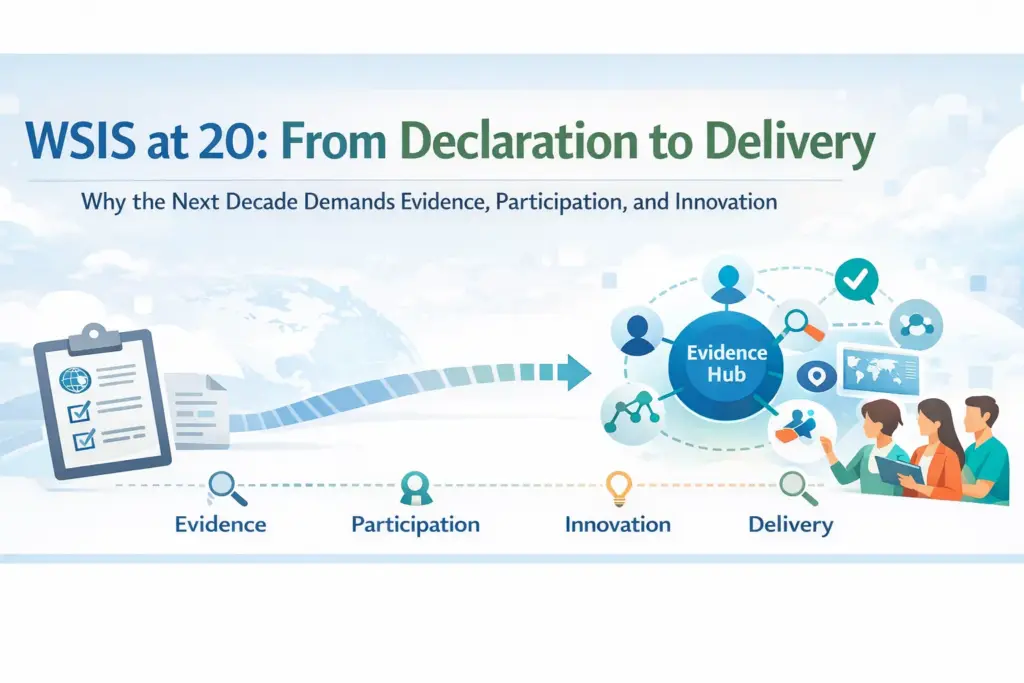 As the dust settles on the World Summit on the Information Society (WSIS) 20-year Review, observers are once again asking what the final outcome document—adopted by consensus on 17 December 2025—really delivers. Much like the WSIS+10 review a decade earlier, negotiations were characterized by pragmatism rather than ambition and by a desire to preserve the WSIS framework amid a radically altered technological landscape. And, as in previous cycles, the most critical questions were pushed to the margins in the final days of negotiation, leaving implementation—not text—as the arena where credibility will be tested.
Whether WSIS remains a living framework for digital cooperation—or recedes into diplomatic ritual—will depend less on consensus language and more on the ability of governments, civil society, researchers, and private actors to translate commitments into accountable practice.
This was the core point emphasized during the WSIS+20 High-Level Event intervention: legitimacy in digital governance is not earned by adoption, but by delivery. Participation, rights-anchoring, and accountability are needed at every stage of implementation—not just during negotiation.
Yet twenty years after Geneva and Tunis, the WSIS process still relies on a governance and operational model conceived for another era. The world now operates in a datafied, AI-augmented environment defined by real-time systems, cross-border infrastructures, and unprecedented concentration of digital power. The question is not whether WSIS principles remain relevant—they do—but whether the mechanisms used to operationalize them are fit for purpose.
Below, we’ll outline the same core challenges and opportunities we identified a decade ago, but updated with the realities, tools, and governance needs of 2026.
1. The WSIS Community Still Needs an Evidence-Based Mandate—Now More Than Ever
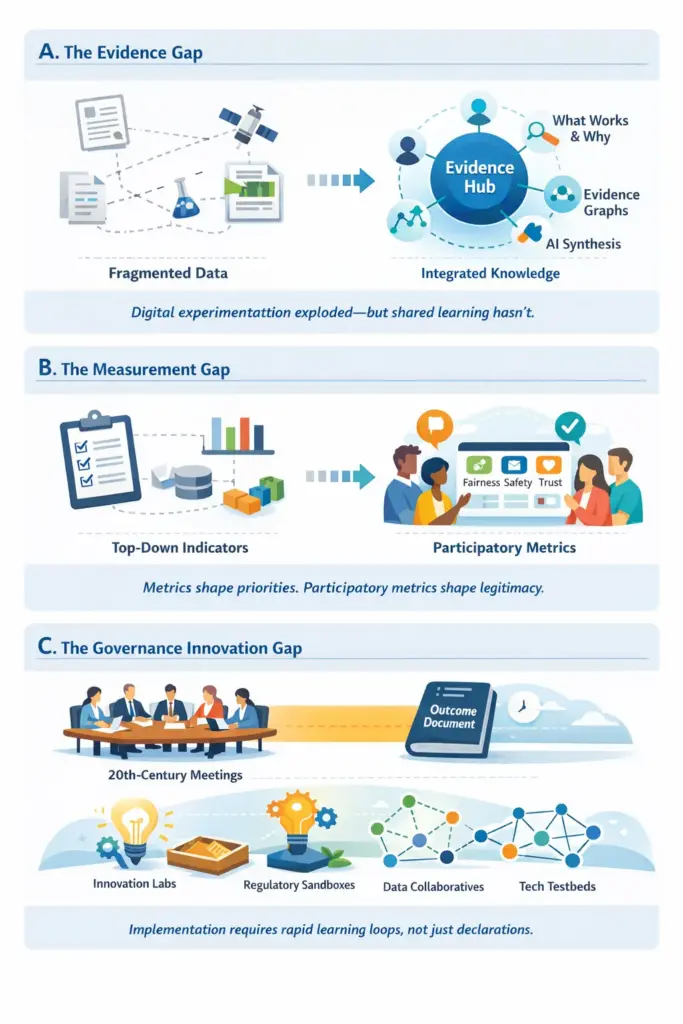
Over the past 10 years, digital experimentation has accelerated globally: from national digital ID systems and AI-enabled public services to data collaboratives, platform regulation, and digital public infrastructure pilots. We now know far more about what works—and what fails—in advancing inclusive digital development.
Yet the evidence remains fragmented, scattered across pilots, think-tank reports, platform case studies, national strategies, and private-sector datasets that remain inaccessible to most of the WSIS community. Worse, reversals have emerged: the rise of a Data Winter in which access to data for public-interest purposes is shrinking even as AI systems feed on vast amounts of data.
WSIS+20 does not meaningfully address these knowledge gaps.
Practical steps remain urgently needed:
- Create regional “What Works & Why” Observatories using new analytical tools (AI-assisted synthesis, meta-review platforms, and evidence graphs).
- Build shared evidence repositories powered by knowledge graphs, RAG systems, and transparent provenance—improving discoverability and quality.
- Institutionalize “learning budgets” in national digital strategies to fund evaluation, monitoring, and rigorous counterfactual research.
- Convene global research sprints and evidence-a-thons at WSIS and IGF to translate research into decision trees, benchmarks, and implementation toolkits.
Twenty years into WSIS, we still lack the basic infrastructure for shared learning. Without an evidence-based foundation, implementation will again drift toward aspiration rather than impact.
2. Progress Must Be Measured Collaboratively—Using Bottom-Up Metrics That People Trust
WSIS commitments risk remaining symbolic unless they are paired with concrete, legitimate, and transparent measures of progress. But measuring digital progress in 2026 is far more complex than in 2005 or 2015. Digital inclusion now involves issues such as:
- algorithmic fairness;
- data governance maturity;
- digital safety and well-being;
- computational access;
- platform accountability;
- cross-border interoperability;
- social license for data reuse, etc.
Yet WSIS continues to rely heavily on top-down indicators that do not reflect lived experiences or community priorities.
A next-generation measurement approach is needed:
- Participatory metrics design using deliberative processes, digital assemblies, or serious games.
- Crowdsourced data and citizen observatories for tracking digital rights, connectivity quality, or platform harms.
- Trust and legitimacy indicators, not only access and infrastructure.
- Real-time dashboards grounded in open data, PETs (privacy-enhancing technologies), and transparent methodologies.
This is not merely technical; it is political. Metrics shape priorities. If communities do not recognize themselves in the indicators, progress will remain contested and legitimacy will erode.
3. WSIS Must Embrace Governance Innovation—Advancing Digital Policy Innovation
The past decade has seen an explosion of governance innovations within and beyond the UN ecosystem as it relates to digital policymaking:
- Participation technologies enabling large-scale consultation, crowdsourcing, and collective intelligence.
- Impact challenges and open innovation prizes accelerating problem-solving.
- Data collaboratives that responsibly unlock private-sector data for public-interest use.
- Algorithmic audit frameworks and regulatory sandboxes developed by regulators, researchers, and journalists.
- Digital self-determination initiatives enabling communities to shape how data about them is used.
- Global model governance efforts linking model cards, transparency standards, and evaluations.
The WSIS framework itself offers hope of more innovative governance solutions through its commitments to multistakeholder, bottom-up, community-driven approaches to governance. Yet these commitments do not translate meaningfully into WSIS+20 implementation plans. The WSIS process remains anchored in 20th-century proceduralism—meetings, declarations, and reporting cycles—rather than in new implementation infrastructures, experimentation, and rapid learning loops.
Concrete innovations WSIS could adopt and advance immediately:
- WSIS Innovation Labs linked to UN agencies, national digital ministries, and research institutions.
- Digital Public Infrastructure (DPI) testbeds to evaluate governance conditions, interoperability, and safeguards.
- Regulatory sandboxes for AI and data governance focused on public-interest use, not only market efficiency.
- A global Data Stewardship Network to professionalize and support the people responsible for operationalizing WSIS commitments.
4. Where Progress Might Actually Happen: Leveraging the IGF’s Permanent Mandate
One of the most consequential outcomes of WSIS+20—though understated—is the decision to grant the Internet Governance Forum (IGF) a permanent mandate and to task it with improving its working modalities, especially government engagement. Importantly, this mandate did not come with a budget and lacks a roadmap for how reforms should occur.
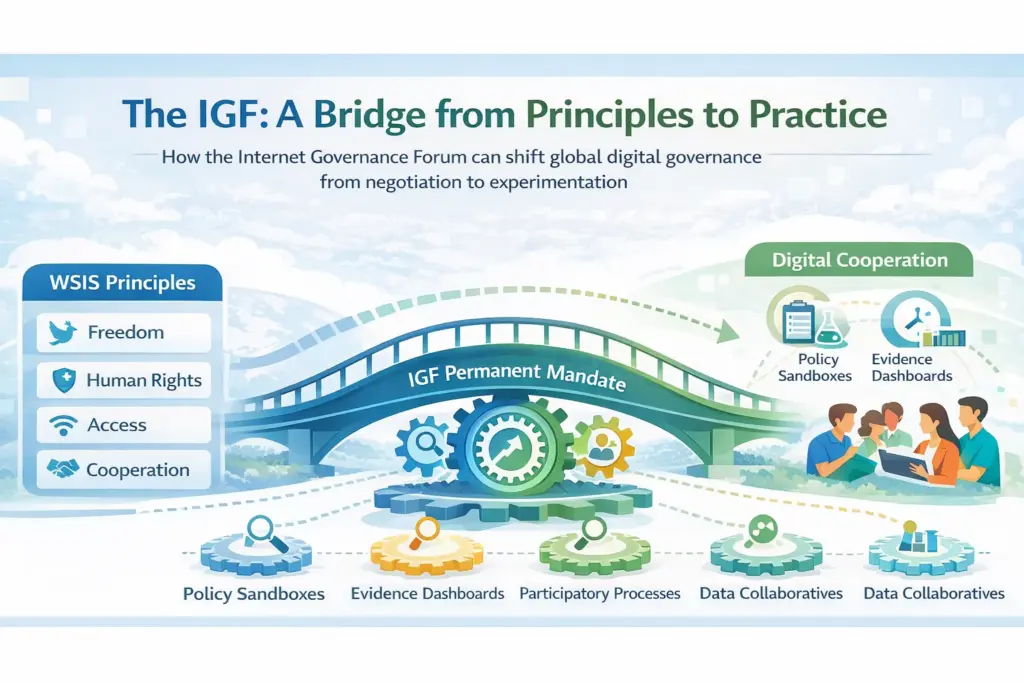
This combination of permanence and ambiguity creates a rare opening. Unlike formal negotiation bodies, the IGF can prototype without requiring consensus on final outcomes.
In a global multilateral environment marked by stalemate, geopolitical tension, and institutional gridlock, the IGF may be the most agile venue capable of testing some of the innovations mentioned above, such as:
- bottom-up governance mechanisms
- participatory metrics design
- evidence-synthesis platforms
- data stewardship networks
- policy sandboxes and regulatory experimentation
- collective intelligence processes
- multi-actor data collaboratives
The IGF can become the place where not just dialogue occurs, but innovation in governance—pilot projects, testbeds, learning loops, and demonstrable delivery.
The permanent mandate should not be interpreted as an administrative update. It is an invitation to reinvent how global digital governance can work when formal diplomacy is blocked.
Conclusion: WSIS+20 Is Not an Ending: It Is an Accountability Test
WSIS remains one of the few global spaces explicitly linking digital development, rights, governance, and cooperation. But its influence will depend entirely on what happens next.
The core challenge is less about reaffirming principles and more about enabling delivery. That will require:
- evidence to inform decisions,
- metrics people trust, and
- innovations that match 21st-century realities.
WSIS+20 offers a baseline — but the real work lies in transforming commitments into outcomes. For that, the community must adopt the tools of the information society to solve the challenges of the information society.
The next decade must shift from negotiation to experimentation, from aspiration to accountability, and from declarations to delivery.